Normandale Lake Project Feedback
 Share Your Feedback
Let us know how you think the Normandale Water Quality Project Improvement Project is going. Share your feedback with the Nine Mile Creek Watershed District by taking a survey.
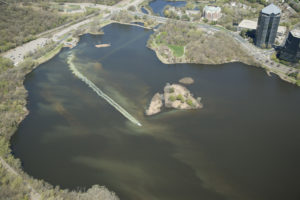
The goals of the Normandale Lake project are to improve water quality and the ecological health of Normandale Lake. To date, the projects that have been implemented at Normandale Lake have included a lake drawdown (2018-2019), aluminum (alum) treatment (2019), and herbicide treatment (2020).
Thank you to everyone that took the survey. Read the results of the survey: Normandale Lake Survey Results Summary (PDF)
Additional Project Information
Normandale Lake project webpage
Normandale Lake Community Meeting Presentation (February 18, 2021)
View Video Transcript
Good evening. Thank you for joining us tonight to hear updates on the Normandale Lake water quality improvement project. My name is Erica Sniegowski, I’m a staff member at the Nine Mile Creek Watershed District. Randy Anhorn is also here tonight with the Nine Mile Creek Watershed District, along with Janna Kieffer and Keith Pilgrim from Barr Engineering Company.
A few logistics to start with: while the presentation is going on, please have yourself on mute. If you accidentally unmute yourself during the presentation, staff will mute your microphone for you. If you have questions during the presentation, you can put those questions in the chat box… if you have additional questions that we can’t answer during the presentation, we will be going into breakout rooms following the presentation where staff will be available to answer questions and have discussion about Normandale Lake.
With that, let’s get started. On behalf of the staff and managers at the Nine Mile Creek Watershed District, thank you again for joining us here tonight. The Nine Mile Creek Watershed District is a public entity that works to protect and restore the water and natural resources in the 50 square mile land area draining to Nine Mile Creek. We serve the residents, property owners, and visitors of the cities in our district: Bloomington, Eden Prairie, Edina, Hopkins, Minnetonka, and Richfield.
To understand the Normandale Lake water quality improvement project, it is important to understand the history and characteristics of this lake. Normandale Lake is a constructed lake built for flood control that was envisioned in the district’s very first water management plan in 1961… The lake was eventually constructed in the late 1970s in partnership between the City of Bloomington and the district. It is currently about 116 acres in size and has a three-foot average depth.
This map shows that 21,000 acres of land from six different cities drain to Normandale Lake through the Nine Mile Creek system. This large watershed area brings pollutants flowing into the lake from Nine Mile Creek, including both phosphorus and nitrogen, which can fuel algae growth… The district has implemented a series of projects upstream in the past and continues to implement projects that will help improve the health of Normandale Lake.
Normandale Lake is a shallow lake, which means sunlight reaches the bottom of the lake, allowing plants to grow throughout the lake. Healthy shallow lakes have a variety of native plants growing throughout the entire lake. The plants take phosphorus and nitrogen from the lake water, reducing the amount of nutrients available for algae. Aquatic plants also provide habitat for insects, fish, and other wildlife. Without aquatic plants, shallow lakes tend to be dominated by algae and turbid or not clear.
Normandale is not currently listed as impaired by the Minnesota Pollution Control Agency; however, past and current monitoring have shown phosphorus levels in the lake above state water quality standards. Chlorophyll-a and water clarity have historically met state standards… To work towards the goal of improving water quality and the ecological health of Normandale Lake, the district and partnership with the City of Bloomington has so far implemented a lake drawdown, alum treatment, and herbicide treatment at Normandale Lake.
The lake drawdown and herbicide treatment have worked towards managing curly leaf pondweed (an aquatic invasive species), and the alum treatment worked towards controlling internal phosphorus loading. The district is implementing these projects in a phased approach and conducting monitoring to evaluate the results of these projects.
[The presentation then transitions to Keith Pilgrim and Janna Kieffer from Barr Engineering detailing in-depth charts on historical water quality testing, including Total Phosphorus (TP) levels, Chlorophyll-a readings, Secchi disk transparency measurements, dissolved oxygen trends, phytoplankton composition, curly-leaf pondweed turion surveys, plant biomass, and the plant index of biological integrity (IBI) indicating overall ecological recovery.]
[Randy Anhorn then details next steps and current adaptive management strategies:] We’ll continue our carp management to address internal nutrient loads and to provide a more healthy fish population. Last year we got 5,000 fish… Also, we’ll continue our herbicide treatments on curly leaf pondweed… If we’re unable to make it to that objective after those two to five years of herbicide treatments and carp management, there are other tools in the toolbox we would potentially look at, such as an oxygenation system to address low dissolved oxygen levels in the lake, and aquatic plant harvesting taking the top foot or so off floating plants to increase oxygen transfer.
Basically, that’s all I have. We’ve kept you here quite a long time, but we’re going to go into breakout rooms and try to answer those questions and compile your comments.