Hopkins
Background:
Central Park’s History:
Central Park has seen many uses over time. From 1910 to 1962, it served as the Hennepin County Fairgrounds. After the fairgrounds closed, the area was used as an unregulated dump site from 1964 to 1971, and later as a permitted landfill managed by the City of Hopkins until 1980. Because of these past uses, some areas of the park contain contaminated soil. As part of the redevelopment project, contaminated soils that are interacted with will be safely removed and disposed of according to Minnesota Pollution Control Agency guidelines.
Project Details:
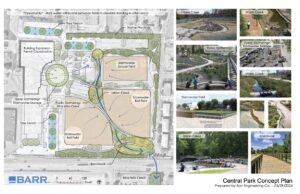
The Central Park Improvement project is a City of Hopkins-led project aiming to improve park amenities while also improving stormwater function, flood reduction, and habitat in a holistic approach to parcel redevelopment. The City of Hopkins has partnered with the Nine Mile Creek Watershed District throughout the design of the project and collaborated on green infrastructure development within the park.
Green Infrastructure key benefits include:
-
Up to 20 acre-feet of new flood-storage capacity, helping protect nearby neighborhoods.
-
A 20% reduction in peak flows to Nine Mile Creek during a 100-year storm.
-
New stormwater-filtration features throughout the park that clean water before it reaches the creek.
-
A dry creek bed, designed to mimic a natural headwaters area and bring nature closer to Hopkins’ downtown.
How NMCWD got involved:
NMCWD has been studying flooding across the watershed and looking for opportunities to add flood-storage areas. Central Park emerged as a promising location to integrate innovative stormwater management into a broader park redevelopment. At the same time, the City of Hopkins was working on its Park System master plan and identified Central Park as the priority park for improvement and a collaboration project slowly developed.
The City of Hopkins also recognized the opportunity to improve stormwater capture and flood reduction while also improving park amenities for residents, achieving multiple community goals within a single city parcel.
Green infrastructure components of the park:
-
A sunken soccer field that can hold stormwater during heavy rains.
-
A dry creek bed that improves drainage and reconnects the site to its natural history.
-
Green infrastructure that filters runoff, improves water quality, and supports climate resilience.
-
Restored natural areas planted with native species to replace underused lawn areas.
Project Update:
Phase 3 of Construction Begins Next Week-
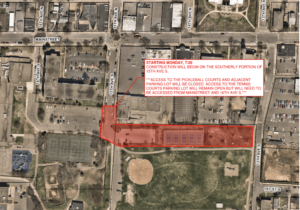
Starting Monday, July 20, construction will start on the southerly portion of 15th Avenue S. (see map below). This area of construction will be closed off from traffic during this phase of work. Access to the tennis court parking lot will remain open but will need to be accessed from the Mainstreet & 16th Avenue S.
Find more information on the projects website: https://clients.bolton-menk.com/hopkinscentralpark/
Project Timeline:
- February 6, 2025: NMCWD and the City of Hopkins signed a cooperative agreement to explore stormwater-management improvements, flood-risk reduction, and options for creating a new headwaters area for Nine Mile Creek.
- February 2025: NMCWD awarded Hopkins a $50,000 grant to expand its stormwater-storage feasibility study.
- April 2025: Central Park was added as a capital project in NMCWD’s Watershed Management Plan.
- May 2025: The City of Hopkins received a $5 million grant from the Minnesota Pollution Control Agency.
- August 2025: Hopkins City Council approved funding for the project.
- September 17, 2025: NMCWD Board of Managers officially ordered the project.
- November 18, 2025: NMCWD and Hopkins signed a funding agreement. NMCWD will contribute $1.5 million to the project.
- February 2026: Hennepin County awarded the project $800,000 to help with contaminated soil management through the county’s Emergency Response Fund
- March 16, 2026: Hopkins City Council accepted Park Construction Company as lowest bid and approved entering into a contract to construct the project
- May 19, 2026: Groundbreaking ceremony at Central Park- construction has started!
Questions?
Contact Lizzy Boor, Grant and Project Coordinator, at p: 952-395-8207, e: eboor@ninemilecreek.org