Edina
Background:
Lake Cornelia and Lake Edina are shallow lakes with poor water quality that are on the state’s impaired waters list for excess nutrients. The Nine Mile Creek Watershed District is working to control nutrient levels (specifically phosphorous) in Lake Cornelia and Lake Edina.
Project Updates:
A new monitoring buoy has been deployed in North Cornelia Lake to help us better understand what’s happening beneath the surface. The buoy measures lake level, water temperature, and dissolved oxygen (DO) and sends readings to a web-based monitoring portal three times a day, as long as cell service is available.
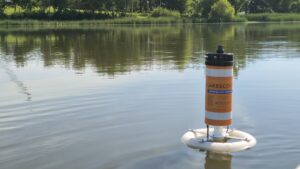
dissolved oxygen in the water.
This information will give NMCWD staff a better picture of changing conditions and help inform decisions about how to improve fisheries.
One of the most interesting things the buoy measures is dissolved oxygen—the oxygen available in the water for fish and other aquatic life.
During the day, dissolved oxygen typically increases as plants and algae use sunlight to photosynthesize and release oxygen into the water. After sunset, photosynthesis stops, and plants and algae continue to respire, using oxygen from the water. As a result, dissolved oxygen levels generally decline throughout the night and reach their lowest point in the early morning hours.
Also, as the water is warmer on these hot days and stretches of days, the lake water has a tougher time holding onto oxygen. More dissolved oxygen can dissolve in cooler water. The giant swings in dissolved oxygen can be one indication of an algal bloom since essentially more percentage of the lake is filled with photosynthesizing biomass, as compared to lakes with low algal presence and fewer plants.
The buoy will remain in North Cornelia through the winter, allowing us to monitor oxygen levels when the lake is covered by ice. This will help us determine if and when dissolved oxygen levels drop low enough to stress native fish and whether a water agitator should be installed to help introduce additional oxygen into the lake.
Here is the link to the dashboard
——–
Since May, the watershed district has conducted weekly goldfish and carp removal efforts in North and South Cornelia Lakes. Curly-leaf pondweed (CLP) treatment was applied this spring, and aquatic plant surveys are planned for August to assess vegetation in both lakes. The survey results will help determine whether additional treatment for hybrid watermilfoil is needed and, if so, the appropriate extent of that treatment.
Staff are also compiling data to quantify the number of fish removed through box-netting efforts so far this season.
Community Engagement:
On September 16, 2026 there is a public hearing on iron and aeration treatments for North Cornelia Lake. The public is welcome to attend. The public hearing will take place at the NMCWD office at 12800 Gerard Drive, Eden Prairie from 5:30-7:30p. Or you may attend virtually. click here to join the meeting online
On August 24th there was a community meeting at the City of Edina Public Works building.We discussed current lake conditions, upcoming recommended projects, potential timelines, and how these projects could affect the lakes. We also walked residents through the public hearing process, which happens before a project is ordered, including how it works, what to expect, and how you can participate. click here for the slide presentation
Project Timeline:
The Nine Mile Creek Watershed District (District) and City of Edina are completing a multi-phased project to improve the health of Lake Cornelia and Lake Edina. As part of the overarching project, the District and City of Edina have completed several projects:
- 2017-2022: the City of Edina conducted annual lake herbicide treatments on Lake Cornelia to control curly leaf pondweed
- 2020: NMCWD ordered an in-lake alum treatment on Lake Cornelia
- 2021: The District installed a stormwater filtration vault located in Rosland Park
- 2023: The District and the City of Edina retrofitted Lynmar Basin to hold and treat more stormwater before it reaches Lake Edina
- 2024: The District took over the Endothall treatment
- 2024: Water Quality Monitoring Report: Lake Cornelia’s North Basin
- 2024 Water Quality Monitoring Report: Lake Cornelia’s South Basin
- 2025: The District switched to the herbicide Galleon. (Galleon is a selective herbicide which means it targets a specific species of aquatic plant. Galleon was chosen for this herbicide treatment to minimize impacts on the native plants growing Lake Cornelia)
- 2026: Spring, herbicide treatment was applied.
Beyond this, the District is working with WSB and Associates to manage goldfish in the Lake Cornelia system. The District will also assess the need to improve oxygen conditions in the lake, after evaluating monitoring data.
Project Details:
Goldfish Management
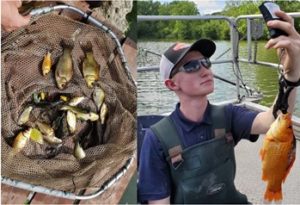
To help improve water quality and the ecological health of Lake Cornelia and Lake Edina, the District is undertaking goldfish management.
Goldfish are an invasive species of fish that cause water quality problems due to their bottom feeding behavior. They stir up lake bottom sediments which reduces water clarity and releases phosphorus. They also uproot aquatic vegetation, destroying habitat for waterfowl and aquatic communities.
The goldfish population was likely started with the release of pet goldfish into one or more of the lakes within the system. Awareness and public education are needed to prevent this from happening in any small ponds that could perpetuate the invasive goldfish population in the Cornelia chain.
A 2018 fish summary indicated that while there were carp, another invasive bottom-feeding fish, in the Lake Cornelia system, they were not abundant. Goldfish, on the other hand, were plentiful and at a level where management of the population is recommended for water quality purposes.
A follow-up goldfish and carp study was completed in 2020 to assess goldfish and carp levels, track inter-waterbody movement through the Lake Cornelia system and test management/removal methods. Surveyors found a large number of young of the year goldfish in the lake, indicating successful goldfish recruitment (survival to the juvenile stage).
The District will continue to study and manage the goldfish population in the Lake Cornelia system, to determine the best methods for goldfish removal and population management.
The District received grant funding for the goldfish studies on Lake Cornelia from the Minnesota Board of Water and Soil Resources through the Clean Water, Land and Legacy Amendment and from Hennepin County through their Aquatic Invasive Species Prevention program.
Cornelia Lake System fisheries assessment for 2020 Report
District Goldfish Study Featured In the News:
In summer 2025, the District partnered with the Minnesota Zoo to provide collected goldfish and invasive carp as food for zoo animals — a unique collaboration that even caught the attention of WCCO the Star Tribune.
View video summary
A WCCO News story about goldfish in Edina’s Lake Cornelia. Groups like the Nine Mile Creek Watershed District have removed thousands of goldfish, most likely descended from released pets, from the lake. The goldfish were more abundant than any native fish there, and they stir up the lake bottom, releasing phosphorus that fuels algae blooms and clouds the water.
Instead of going to a landfill, the fish now feed bears, otters, and sea lions at the Minnesota Zoo, through a partnership permitted by the Minnesota DNR. Zoo staff explain that fish are a natural part of these animals’ diets and that the partnership supports the zoo’s conservation message, though the animals may need time to get used to the new food. The District says the partnership is the first of its kind in the state.
In this Minnesota Bound episode (filmed in 2020) you can see the goldfish research team in action starting at around 1:20, as they collect information on goldfish in the Lake Cornelia system in Edina.
View video summary
An episode of the TV show Minnesota Bound. The first segment covers invasive goldfish in Edina’s lakes.
A research crew uses electrofishing on Lake Cornelia to estimate how many goldfish live there, catching nearly 50 in about 11 minutes. Researchers believe the population started with pet goldfish dumped into the lake, which can multiply into the thousands. The fish lose their bright orange color over time and within a year or two grow too large for predators to eat. The crew implants small tracking tags so monitoring stations around nearby lakes can follow where the fish travel, which will help shape a management plan. Goldfish also stir up silt and cloud the water. A Hennepin County aquatic invasive species specialist asks people never to release pet fish into lakes.
The rest of the episode is unrelated to the District: Hopkins police officers take local kids fishing on Lake Minnetonka, and the hosts take an ATV trip through the Black Hills of South Dakota.
The City of Edina takes a look at water quality in Lake Cornelia and goldfish in this featured video.
View video summary
An Edina TV story about water quality in Lake Cornelia, Edina’s largest lake. Erica Sniegowski of the Nine Mile Creek Watershed District explains that Lake Cornelia and Lake Edina are on the state’s impaired waters list because too much phosphorus enters them. Storm sewers carry runoff from the Southdale area, including grass clippings, leaves, and pet waste, straight into the lake.
Goldfish, which started with people releasing pets, add to the problem. As bottom feeders they stir up sediment, clouding the water and releasing nutrients that feed algae, some of it toxic to people and pets. An environmental scientist with the engineering firm WSB describes a study of where young goldfish survive and whether those nursery areas flush fish into the lakes. A lakeshore resident baits a large box net with cracked corn every evening; on the day shown, the net caught about 57 goldfish and seven common carp.
The study was scheduled to finish in fall 2022, with surveys before and after removal to measure progress. The District is funding the work with help from a Clean Water Fund grant and a Hennepin County aquatic invasive species grant.
How can you help Lake Cornelia and Lake Edina?
If you have unwanted aquarium fish or plants, never dump them in a lake, creek or pond. Always surrender them at a re-home event.
You can also Adopt a Drain to keep pollution from entering the water in the first place. Learn more at mn.adopt-a-drain.org.
Studies and Reports
Visit the Lake Cornelia and Lake Edina Study page to read the lake water quality study and feasibility reports.
Questions?
Contact Jordan Wein, Water Resources Project Manager, at 952-800-8307 jwein@ninemilecreek.org