
Is your plow service smart salt certified?
Smart Salt Certification
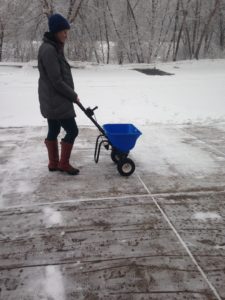 Contractors who manage snow and ice can learn practices to use salt effectively, while maintaining safe surfaces in the winter at free Smart Salting workshops hosted by the Nine Mile Creek Watershed District and other local organizations. Contractors who have attended the training, passed a test, and agree to use practices that reduce salt impacts on the environment are certified by the Minnesota Pollution Control Agency in Level 1 Smart Salting.
If you hire a contractor to manage snow on your property, check to see if they are certified. If not, have them attend an upcoming Smart Salt training. For a list of upcoming training dates, visit the Minnesota Pollution Control’s website at: www.pca.state.mn.us/water/smart-salting-training.
Anybody who maintains entryways, sidewalks, or other small areas should watch this video by Fortin Consulting.
View video summary
A training video from the Mississippi Watershed Management Organization and the University of Minnesota on safely clearing snow and ice from small spaces like steps, ramps, entryways, and curb cuts while using less salt. It is presented by a land care supervisor at the University of Minnesota.
- Most deicers are chlorides, and salt that washes into storm drains goes straight to lakes and rivers without treatment. One teaspoon of salt permanently pollutes five gallons of water.
- Remove snow mechanically first, by shoveling, plowing, sweeping, or scraping, and start early to avoid compacted snow. Deicer spread on top of snow only creates slush.
- Choose the right tool: brooms for light snow, scoop or push shovels for heavier snow, and ice scrapers or chisels for ice. Use proper lifting technique and dress in layers.
- Match the material to the pavement temperature. Rock salt works down to about 15°F; magnesium and calcium chloride work at colder temperatures. Below zero, use sand for traction, and sweep it up once it is on bare pavement. On warm days when snow is already melting, use nothing.
- Apply 4 pounds of deicer or less per 1,000 square feet, with granules spread about 3 inches apart. A heaping coffee mug holds about one pound. Hand spreaders give a more even pattern than scoops.
- Sweep up extra deicer, and report problem spots, like dips that collect water or roof drips that refreeze, to a supervisor.