Eden Prairie
At Discovery Point, we are working towards increasing plant diversity and improving urban habitat through restoration and continued project maintenance.
Restoration Vision
The District’s vision for Discovery Point is to care for the land by improving urban habitat. We want Discovery Point to be a demonstration site within the District for property owners to learn how to conduct invasive species removal projects, stabilize soils, increase plant diversity in an urban setting, and understand maintenance associated with a habitat restoration project.
Restoration Goals
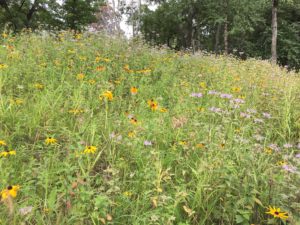
- To demonstrate the process of invasive species control, native plant establishment, and project maintenance
- To be a teaching site for the regeneration of upland native plant communities
- To demonstrate native landscape management process, techniques, and expenses
- To meet the terms of the MN Land Trust Conservation Easement on the property, which are intended to provide significant public benefit
History of Restoration Work
Habitat restoration began at Discovery Point in February of 2017, and the last phase of work began in April 2021. The project is now in a site-wide maintenance phase. The work was guided by an ecological master plan.
Phase 3
Northwestern Section
The Nine Mile Creek Watershed District completed the final phase of habitat restoration on its property. MNL, the contractor hired to complete this phase, removed buckthorn and other woody invasive species. Select trees were also removed. MNL used a forestry mower for the buckthorn removal work. After buckthorn removal, MNL installed a native seed mix. This work began on April 1, 2021, and was finished the following week. MNL installed fifty shrubs and eighteen trees, completing the habitat restoration in June 2021. This final phase of restoration was done in partnership with the City of Eden Prairie and included buckthorn removal and native seeding on adjacent city property.
Fescue Conversion of Southeastern Section
On May 12, 2021, Red Rock Fire (a MNL company) conducted a small prescribed burn in a 0.4 acre fescue grass area on the southeast part of the District’s property. The purpose of the burn was to prepare the area for a native prairie planting. Permits for the burn were issued by Eden Prairie and the Department of Natural Resources. The area was then seeded with a native seed mix and cover crop the next day.
Watch the video below for an overview of phase 3.
View video transcript
Hi, my name is Erica Sniegowski, I’m a program and project manager with the Nine Mile Creek Watershed District. I’m going to give you an introduction to the Phase 3 habitat restoration work that is happening at our office site.
The vision for the habitat restoration on our site is to restore habitat in the face of aggressive invasive plant species like buckthorn, and to demonstrate for property owners within the district how to stabilize soils, control invasive species, and increase plant diversity in an urban setting. This work is guided by an ecological master plan that was developed by Barr Engineering, which is available on our website, and the work is occurring in a phased approach. We have completed phase one and two and are working on phase 3, which is the final phase.
The goals for the habitat restoration on our site are to increase plant and animal diversity on our site, to support pollinators, limit soil erosion, highlight native plants, and demonstrate buckthorn removal and restoration techniques for those that live, work, and play in our watershed district.
As I mentioned, the habitat restoration work on our office site has occurred in phases. Phase one began in February 2017 with buckthorn removal and was followed in May and June of 2017 with planting. Part of the site was planted in native plants, and the other part of the phase one site was planted with fescue. This was to demonstrate for those interested in buckthorn removal different planting techniques and different maintenance regimes that might need to be undertaken following buckthorn removal.
Phase two occurred in November 2017 and began with buckthorn removal and was followed by a full native planting of the site in September 2018. We’ve also done volunteer buckthorn removal events and volunteer native plug planting events in both phase one and phase two.
Phase three of the restoration will take place on two different parts of our site. We are converting part of the fescue area that was part of the phase one planting into native. We’re choosing to reduce the amount of fescue we have and increase the amount of native planting we have on this section. The other part of phase three will be buckthorn removal on this section of the property, and it will not only include buckthorn removal from the Discovery Point property but will also include buckthorn removal from City of Eden Prairie property.
Following buckthorn removal, we will plant this area with native woodland species of plants. This work will begin in the spring of 2021. The work will be done with a forestry mower, which is the machine shown in the picture. This machine knocks down and shreds up the buckthorn, and this work is anticipated to take about two days on our property. The work will be done by Minnesota Native Landscapes, which is a contractor that does buckthorn removal and native planting. The planting plan includes planting 50 shrubs and five trees and planting with a woodland seed mix in the area that’s shown in the picture right now and a savannah seed mix in the fescue replacement area.
During the approximately two days that the forestry mower is working on our site and the City of Eden Prairie’s property, there will be some trail closures on the Cardinal Creek Trail. This is for the safety of pedestrians as they’re walking along the trail, as the forestry mower can send debris flying through the air, so please watch for signs that the trail is closed and respect those trail closures.
We’re excited to embark on the last phase of our restoration and to reflect on the impacts of the restoration on our site. In that, we’ve planted over 275 shrubs and 100 trees, 2,000 native plugs, and put in over two and a half acres of native seed, and brought in over 100 new native species to our site and removed over two and a half acres of buckthorn. We’ve also logged hundreds of volunteer hours since we brought volunteers in to help remove buckthorn and plant native plugs.
If you’re interested in helping, visit our website ninemilecreek.org/discovery-point and watch for volunteer events there in the future, and we also have our planting lists available if you’re interested in the plants that we’ve installed at our site. If you’re interested in doing habitat restoration work at your site, we also have grants available. Go to ninemilecreek.org/grant and you can view the information available. Those projects must be located within the boundaries of the Nine Mile Creek Watershed District, and we have different levels of grants available for different sites.
If you live in the City of Eden Prairie, the City of Eden Prairie also has landscaping rebates available, which can include rebates for buckthorn removal, so you can check those out at edenprairie.org/water-rebates. If you have questions about phase 3 or about any of the habitat restoration work we’ve been doing at Discovery Point, please feel free to reach out. My name is Erica Sniegowski and I can be reached at esniegowski@ninemilecreek.org or you can give me a call: 952-358-2276. Thanks.
Phase 2
Southwestern Section
- Buckthorn and invasive honeysuckle and select tree removal (completed November 2017)
- Native seeding, tree and shrub planting (completed fall 2018)
- Volunteer plug planting (completed spring 2019)
Phase 1
Southeastern Section
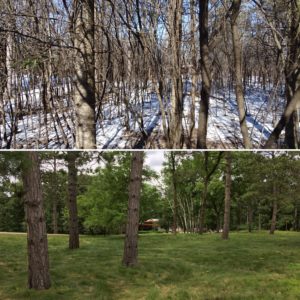
- Buckthorn, invasive honeysuckle and tree removal (completed February 2017, Learn More)
- Seeding of native mix and no-mow fescue and tree/shrub planting (completed May & June 2017)
- Native plug planting (completed June 2018)
North of Parking Lot
- Buckthorn removal (completed October 2016 and 2017 by volunteers)
- Fescue (no-mow) grass seeding (completed May 2017)
Weir Area/City Trail Connection
- Buckthorn removal (completed February 2017)
- Tree and shrub planting (completed June 2017)
- Split-rail fence installation to define the connection between the city trail and Discovery Point (completed April 2017)
Whole Site
- Control of noxious invasive weeds, including garlic mustard, narrowleaf bittercress, and buckthorn resprouts (ongoing)
Learn More: Discovery Point Ecological Master Plan_2021
What was planted?
Since 2014, the District has planted more than 300 shrubs and 100 trees at Discovery Point. Volunteers have helped install over 2,000 native plants. Over 2 acres of land have been seeded with native seed mixes.
Learn what was planted: Discovery Point Plant Lists

Buckthorn is an invasive plant that creates a dense thicket in forests. It shades out native plants and has little value to wildlife. More information>
Questions?
If you have questions about the restoration project or would like more information, contact Erica, District Administrator, at 952-658-9024 or esniegowski@ninemilecreek.org.