
Nine Mile Creek is on a “low salt” diet.
SALT POLLUTES
Nine Mile Creek has too much chloride in it. The chloride comes from salt used in the winter on roads, parking lots, and sidewalks. The amount of chloride in the creek make the water unhealthy for the aquatic animals living there.
Tips for Using Less Salt
 It is possible to reduce salt use while maintaining safe surfaces in the winter. Just follow these tips:
Shovel. Clear walkways before snow gets compacted or turns to ice. Apply salt only if needed.
Scatter. More salt does not mean more melting. Aim for 3 inches of space between salt granules. Use salt only where critical.
Switch. Common deicers don’t melt ice below below 15° Fahrenheit (pavement temperature), so should not be applied. Instead, use a small amount of sand for traction when it is too cold.
Sweep. Clean up leftover salt and sand on dry pavement, so it doesn’t wash into the creek. Reuse it as needed.
Check out our video that take you through these steps:
View video transcript
We’ve all seen it: the piles of salt outside a doorway or in the parking lot. Salt blown up against the side of a building or laid down so thick you can crunch it. We know that people do this because they want to keep people safe. We’re not here to shame anybody about oversaltng, but there is a better way.
The Minnesota Pollution Control Agency teaches four different techniques: Shovel, select, scatter, and sweep. Let’s break down these different techniques. The first step is to shovel or snow blow as soon as you can. You might have to do multiple rounds of clearing the snow if the storm lasts long enough. The idea is to prevent foot or vehicle traffic from compacting the snow into ice in the first place.
After you’re done clearing the snow, there still might be some compacted snow or ice left over. You can use a chipper to try and get rid of some of that before moving on to the next step. If you can’t get rid of it with a chipper, your next best option might be using salt. This is where the second step of “select” comes in. Here’s where it gets tricky: the product that you select will depend on how warm or cold the pavement is.
If it’s been really cold—like below freezing, below zero for a while—chances are the pavement is probably cold and salt is going to work a lot more slowly. Most of us don’t have time to wait for salt to do its job, so you might want to switch to sand. That won’t melt the ice, but it will give your feet or tires a little bit of traction as you’re walking around on the ice. However, if it’s been warmer than 15°, chances are the pavement will be a little warm and salt will be fairly effective at melting the ice.
Now that you’ve decided to apply salt, how you scatter it also makes a difference. This is the next step: scatter. Don’t just dump it into a pile or lay it down so thick that it feels like a carpet underneath. Your aim is to get some space in between the grains to give them enough space to work. There are many different techniques for scattering and lots of different tools that can help you get the right scatter pattern.
You could use a salt cup or a coffee mug, which holds about one pound of salt or enough for about 10 sidewalk squares. Keep in mind you shouldn’t be using salt to completely melt the ice away. Rather, just apply enough so that it unsticks the ice from the pavement. That way you can actually get in there and scrape it away with a chipper. You could use a handheld spreader which allows you to get the same kind of scatter pattern, or you could use a push spreader like they use to apply fertilizer. When you’re using that, just make sure that it’s not coming out in big clumps. Check to make sure you’re still getting the right amount of space between the grains.
Salt needs space and time to work most effectively. Let’s break that down a bit. First, the grains shouldn’t be too close together. It’s important to remember that more salt doesn’t equal more melting. So each of these grains have a little bit of space around them instead of being all piled up in a clump. If you’re piling up salt, you’re just wasting money. It’s not going to melt any faster, and all that extra salt is just going to be pollution in our lakes and creeks. Second, salt needs time. So you need to be patient and wait for the salt to actually work its way down to the pavement level to unstick the ice.
Our last step is sweep. Once the ice is gone, look around and see if there’s any product left behind on the dry pavement, like clumps of salt or bits of sand scattered. Sweep that up and reuse it later. Salt on dry pavement isn’t going to melt the snow in the next storm. It’s just going to be extra pollution that gets washed into our lakes and creeks.
Salt is a permanent pollutant. That means once it’s in the water, we don’t have a cost-effective way to get it out again. So it’s in the water forever. Just one teaspoon of salt is enough to permanently pollute five gallons of water. Think about how many teaspoons of salt we put on our roads and parking lots and sidewalks each winter. That’s a lot of pollution. This is why it’s so important to use salt correctly so that it keeps you safe as well as minimizing the harm on our environment. If you want to learn more, search MPCA smart salting and you can find tons of resources on that web page as well as links to trainings. Thanks for watching.
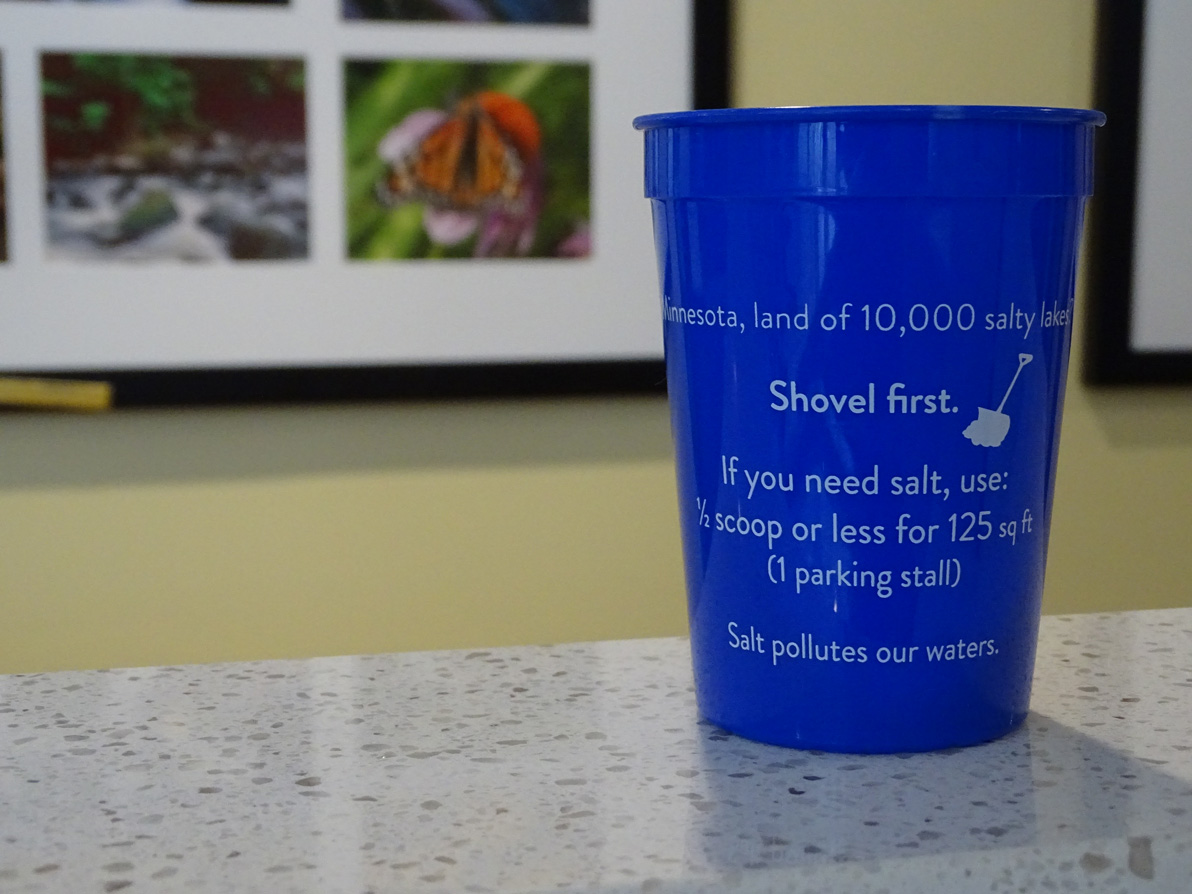
APPLICATION RATES MADE EASY:
Salt Scoop
Get a free Nine Mile Creek salt cup by visiting Discovery Point or contacting the District. Leave this handy salt scoop with your ice melt and always have the application rate on hand

Low Salt No Salt Minnesota
Brought to you by the Hennepin County Chloride Initiative is the Low Salt, No Salt Minnesota Program. The goal is to build relationships with the community in order to maintain winter safety while reducing chloride based deicer. Aimed at local properties that are managed by resident boards, such as condos, townhomes, and faith-based organizations. The program focuses on awareness and technical support which allows us to provide custom support and solutions. Interested in learning more about this chloride reduction program? Contact Gael at gzembal@ninemilecreek.org
Hiring a Snow Removal Service
You can hire a contractor that has agreed to protect our waters by using less salt. These contractors have taken a class and passed a test to become certified by the Minnesota Pollution Control Agency.
For a list of certified individuals, visit: www.pca.state.mn.us/business-with-us/smart-salting-training.
Do you like your current snow removal service, but they aren’t certified? Ask them to attend a free training! Search “MPCA Smart Salting” to find a list of current trainings or contact the Nine Mile Creek Watershed District at 952-658-9024.
Model Contract for Snow and Ice Management
The focus of this model contract is to embrace best practices to minimize environmental impacts from chlorides, sand, and other chemicals, while also maintaining safety and addressing liability risk allocation.
Model Contract for Snow and Ice Management
Model Contract for Snow and Ice Management- Cover Letter
Model Contract for Snow and Ice Management- Explanatory Memo
Certified snow removal contractors have agreed to voluntarily apply best management practices to reduce the impacts from chloride to our lakes and creeks.
Additional Resources
Smart Salt Toolkit
Improved Winter Maintenance: Good Choices for Clean Water
Winter Maintenance for Small Sites
Buying a Deicer (PDF)
Hiring a Contractor (PDF)
Nine Mile Creek Chloride TMDL (PDF)