Bloomington
Background:
The Nine Mile Creek Corridor Renewal Project is a City of Bloomington-led initiative focused on improving parks, trails, and natural resources along Nine Mile Creek. Bloomington voters approved a local option sales tax to help fund major corridor improvements, and the Nine Mile Creek Watershed District (NMCWD) is partnering with the city to support the project’s environmental restoration goals.
On April 16, 2025, the NMCWD amended its watershed management plan to contribute up to $1 million in capital project funding for the corridor renewal effort. On June 17, 2025, the NMCWD and the City of Bloomington entered into a memorandum of understanding to incorporate beyond-compliance streambank stabilization and floodplain restoration into the project. These improvements will enhance water quality, restore habitat, improve floodplain function, and expand public access to natural areas along Nine Mile Creek.
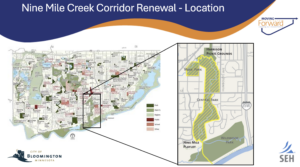
The NMCWD has maintained a long-term presence in the Lower Valley of Nine Mile Creek — the section of creek flowing through central Bloomington, generally from Old Shakopee Road to the Minnesota River. Following the major flood of 1987, the watershed district partnered with the City of Bloomington to preserve the valley walls and creek corridor to support long-term flood management, reduce erosion impacts to nearby infrastructure and trails, and allow the creek to continue naturally meandering through the valley.
In 1993, the watershed district entered into a cooperative agreement with the city to regularly inspect and address significant erosion issues throughout this stretch of creek. Since then, the NMCWD and the city have completed three additional phases of streambank stabilization and bluff protection projects in the Lower Valley, with the watershed district contributing more than $3 million toward these efforts.
The current Nine Mile Creek Corridor Renewal Project represents the largest and most comprehensive investment in the corridor to date. The project will incorporate extensive streambank stabilization, upland habitat restoration, bridge and trail improvements, and expanded public access features — building upon decades of partnership between the NMCWD and the City of Bloomington.
Project Details:
Project Goals and Benefits
The NMCWD is supporting the city-led project through design assistance for streambank stabilization and upland restoration, as well as $1 million in construction funding for four major project components:
- Streambank stabilization practices using biological engineering techniques
- Creek re-meandering to improve floodplain connectivity
- Upland invasive species removal and native habitat restoration
- Construction of a boardwalk to minimize wetland impacts while preserving public access through the corridor
Key natural resource improvements include:
- Stabilizing 22 erosion sites, primarily through biologically engineered streambank restoration
- Adding approximately 1,500 linear feet of in-stream habitat
- Re-meandering portions of the creek to slow flows and reconnect the stream to the floodplain
- Restoring approximately 130 acres of upland habitat to establish a diverse and resilient native tree canopy and understory while reducing erosion
- Constructing approximately 750 linear feet of boardwalk to improve public access through the floodplain ecosystem
The NMCWD and the City of Bloomington have partnered on multiple previous phases of streambank stabilization and bluff protection in the Lower Valley of Nine Mile Creek. The original maintenance agreement for the Lower Valley Improvement Project was established in the early 1990s. As part of the current project, the watershed district and city will work together to develop an updated, comprehensive maintenance plan covering both the new improvements and previously completed NMCWD-funded stabilization work.
Project Updates:
The City of Bloomington held a groundbreaking event for the project on May 5, 2026. Initial tree removal activities have begun and may appear dramatic, but all removals were identified during project planning and approved through the design and permitting process.
Upcoming work includes final permitting approvals and construction bidding for major creek grading, bridge, and trail improvements scheduled over the next year. Community members should expect intermittent trail closures during construction activities.
Additional project information and updates are available on the City of Bloomington’s project webpage: https://www.bloomingtonforward.org/9mile
Community Engagement:
City of Bloomington hosts a Playground Inclusion Community Conversation
September 9, 2025, 6:30-7:30 p.m., Moir Park Shelter 1, 10320 Morgan Ave. S.
-
During this open house-style community conversation, you’ll learn more about accessibility options and have a chance to share your input for inclusive playground design at Moir Park as part of the Nine Mile Creek Corridor Renewal Project.
Check out a new video from the city of Bloomington:
Project Timeline:
April 16, 2025 – The Nine Mile Creek Watershed District (NMCWD) amended its watershed management plan to partner with the City of Bloomington on the Nine Mile Creek Corridor Renewal Project and committed up to $1 million in capital project funding.
June 17, 2025 – NMCWD and the City of Bloomington entered into a memorandum of understanding to integrate beyond-compliance streambank stabilization and floodplain restoration into the project, supporting improved natural area access, habitat enhancement, and water quality improvements.
January 21, 2026 – The NMCWD Board of Managers received a presentation on the design of the Bloomington Nine Mile Creek Corridor Renewal Project.
March 4, 2026 – A public hearing was held during the NMCWD Board workshop to gather public comments on the project. A resident spoke in support of continued NMCWD involvement in the project’s design and implementation.
May 1, 2026 – The NMCWD board of directors ordered the Bloomington Nine Mile Creek Corridor Renewal Partner Project.
May 5, 2026 – The City of Bloomington held a groundbreaking
June 17, 2026- The NMC Lower Valley Management Plan Renewal Project RFP (which is the Natural Resource 5 year project) closed on June 17 and the team is currently reviewing the proposals with the anticipation to award a contact at the August 3 Council meeting.
Questions?
Contact Brett Eidem, Project and Planning Manager, at p: 952-658-9271, e: beidem@ninemilecreek.org